Frequently Asked Questions

How do I use Gleener®?

After attaching the appropriate blade (see How to Gleen), you are ready to Gleen! Lay your garment down on a clean, hard surface. With one hand, hold the garment taut, then with the other hand move the Gleener in a downward fashion. Always be sure to Gleen in the same direction as the weave of the knit. Depending on the size of the pills and the nature of the fiber, you may need to apply more pressure. Still in doubt, click here to see Gleener in action.

Why are there 3 different blades?

Because fibers pill differently, some produce large, bulky pills most commonly found on wool & acrylic sweaters, while other fibers such as cottons, lycra and elastane create ultra fine pills. Three different blades were developed to treat virtually any type of pilling on any type of garment.

How do I know the number of each blade?

Each blade is individually marked on the bottom 1, 2 or 3.

What are the uses of each blade?

  • Blade 1 is ideally used for large, bulky pills or fuzz balls most commonly found on wool and acrylic sweaters and other garments such as coats.

  • Blade 2 is ideally used for medium sized fuzz balls such as those found on finer wools, like cashmere and merino. It is also highly effective on acrylics, polyesters and blends.

  • Blade 3 is ideally used on tiny, fine pills such as cotton and synthetic blends usually found on t-shirts, scarves, and shirt collars.

The information suggested that I should use Blade 3 for my silk blend sweater, but I find that Blade 2 works better. Is that okay?

Of course! The information provided here is just a guide. Every weave is unique. Start with the recommended blade for the fiber you are working with, but experiment with different blades to see which one works best. Just be cautious when Gleening fine fabrics — make sure to test the blade first.

How do I test a blade?

It is a good idea to test a Gleener blade in a non-obvious place, such as on the inside seam of a garment.

When I use Blade 3, the pills stay on the garment rather than the blade. How can I remove the excess pills?

Using Blade 3, most pills and fuzz tend to remain on the Gleened surface. Just flip Gleener around and pick-up the excess fuzz with the built-in lint brush.

How does Gleener compare to other depillers?

It is the only depiller with 3 different fabric-sensitive blades, developed to treat virtually any type of pilling. Also, Gleener doesn't need batteries and you won't have to stop periodically to avoid small-motor-burn-out. There is no odour or gritty residue, and unlike small sweater combs, Gleener is easy to hold and use. Most important, Gleener is efficient and effective!

Is there anything that shouldn't be Gleened?

Although Gleener is highly effective for most garments and upholsteries, it is NOT recommended for use on burn-out fabrics, such as ultra-thin or shear t-shirts. Gleener should also not be used on fabrics that contain embroidery, deliberate textures or very loose weaves.


How long will the blades last?

The longevity of the blades really depends on how often you Gleen. With moderate use, the blades will last one to two seasons.

Can I Gleen my upholstery?

Yes, just be sure to test the appropriate blade in an area out of view. Also, exercise caution if there are any intentional weaves or embroideries.

How often can I Gleen a garment?

Like so many rules in life... moderation! Exercise good judgment, making sure to Gleen within reason.

What is pilling?

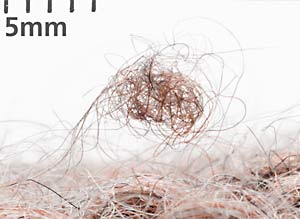
Apart from being annoying, pilling is a very common result of a fabric showing signs of wear by forming small pills (also known as fuzz or balls) on its surface. The zones most affected on garments occur where friction is most common, such as under-arms, sleeves, breast area and upper thighs.

What causes pilling?

Pilling is caused by a slight migration of fibers breaking away from the yarns. These loose ends create fuzz balls that cling to the surface of the fabric. This migration is a result of repeated abrasion, in other words, general wear and tear. These annoying little cling-ons anchor themselves with tiny hooks much like a burr does.

Does pilling mean the fabric isn't of a good quality?

Absolutely not! Pills know few limits — from ultra-luxurious cashmere to simple synthetics, pills are prolific.

Which fabrics and fibers pill?

Most fabrics exhibit some degree of pilling, some to a greater extent than others. All-natural fibers such as cotton and most wool tend to pill less as their construction is weaker than their synthetic counterparts. Synthetics such as acrylic, polyester, rayon, nylon and elastane are inherently stronger and as a result, their anchors are tougher, creating cling-ons that don't want to let go! Also, construction plays a role — a tighter, more compact construction like denims are generally pill-free, while knits have a much looser construction, thus inviting even more pills to the party.

How does Gleener work?

Gleener's patented design including 3 fabric sensitive blades, catch and remove the fuzz, leaving your garment like-new.

How can I avoid pilling?

Good question! Please refer to our Fabric Care page for some valuable tips. We know how important your wardrobe is, and we want to help you get the most out of it!


Copyright © 2010-2011 Gleener Marketing Inc. All rights reserved. Legal & Privacy Information